



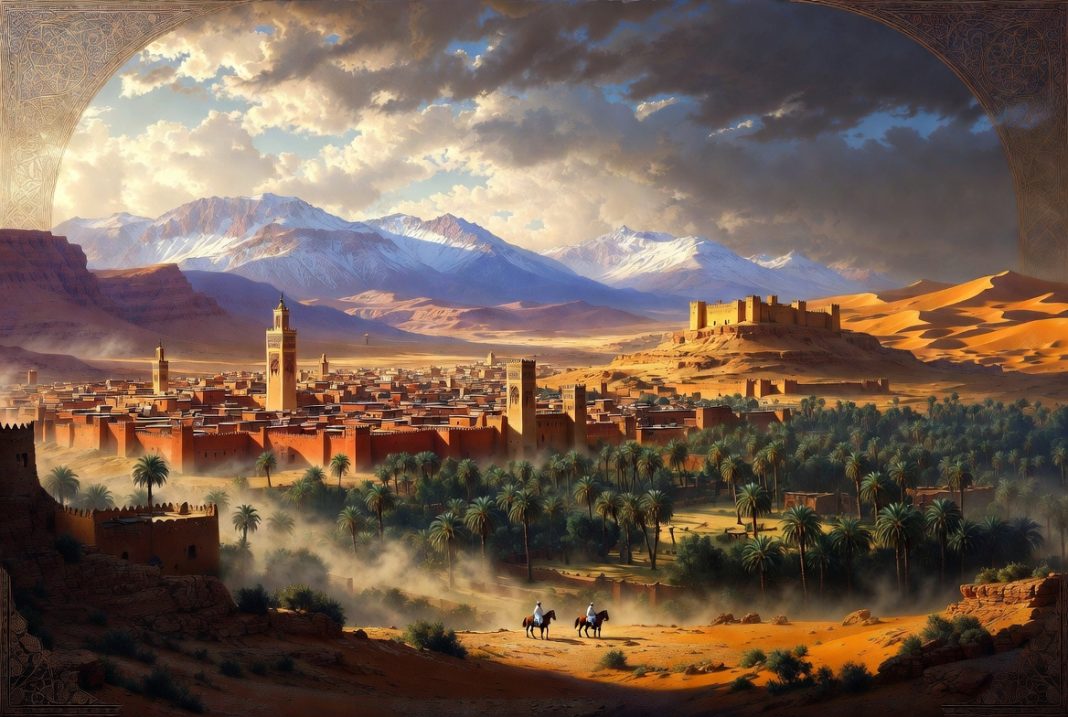
In 1912, France imposed a protectorate on Morocco. The Sultan remained the nominal ruler, but real power rested with French authorities. Resistance grew. In 1953 the French exiled the popular Sultan Mohammed V, triggering nationwide unrest that united Arabs and Berbers against colonial rule.
He returned in November 1955 to massive crowds. Negotiations followed. On 2 March 1956, France signed the declaration ending the protectorate. Power transferred back to the Sultan, who became King Mohammed V in 1957. Morocco was independent again—sovereign under its Alaouite monarch.
The deeper story: Berbers, tribes, and Islam
Long before the French, the Amazigh (Berber) peoples—the indigenous inhabitants of the Maghreb—shaped Morocco’s identity. After the 7th-century Arab conquests, conversion to Islam was gradual and uneven. Many tribes adopted the new faith while keeping their kinship structures, customary law (ʿurf), and mountain autonomy.
Islam did not erase tribal life; it was absorbed into it. Berber dynasties later rose as champions of the faith: the Almoravids and Almohads were Amazigh movements that spread rigorous, reformist Islam across North Africa and into Spain. For many tribes, becoming Muslim meant joining a broader ummah without abandoning local solidarity.
This religious-tribal fusion later mattered under colonialism. The French tried to split Arabs (under Sharia) from Berbers (under customary law) with the 1930 Berber Dahir. It backfired. Berbers rejected the idea that their turf stood outside Islam, and the edict helped forge a shared Moroccan nationalist front around the Sultan.
Independence in 1956 was therefore not only the end of French rule. It was the reaffirmation of a centuries-old synthesis: Amazigh tribal resilience + Islamic legitimacy under the Sultan, restored as the heart of the Moroccan state.
Morocco’s Historical Timeline (from 8th century Islamic expansion to today)
- Late 7th–early 8th century: Arab-Muslim armies conquer the Maghreb. Islam spreads among Berber (Amazigh) tribes; conversion is gradual and mixed with local tribal customs.
- 788–974: Idrisid dynasty founded by Idris I (a descendant of the Prophet Muhammad). First major Islamic state in Morocco; Fez becomes a key political and religious center. Often seen as the foundational Moroccan dynasty.
- 11th century (c. 1050s–1147): Almoravid dynasty (Berber, Sanhaja/Lamtuna tribes). Unifies much of Morocco and western Maghreb; expands into al-Andalus (Spain). Builds Marrakech as capital. Strict Maliki Islam.
- 1147–1269: Almohad dynasty (Berber, Masmuda tribes from the Atlas Mountains). Overthrows the Almoravids; creates a large empire across North Africa and Spain. Strong religious reform movement (tawhid). Peak of Moroccan medieval power.
- Mid-13th–15th century (c. 1244–1465): Marinid dynasty (Berber, Zenata). Takes power from the Almohads; capital in Fez. Cultural and architectural flourishing, but gradual political fragmentation.
- Late 15th–mid-16th century: Wattasid interlude and Portuguese/Spanish coastal pressure. Weak central authority.
- c. 1510/1554–1659: Saadi (Saadian) dynasty (Sharifian, claimed descent from the Prophet). Unifies Morocco, expels Portuguese from many coastal cities, reaches height under Ahmad al-Mansur (Battle of the Three Kings, 1578). Golden age of diplomacy and architecture (e.g., Saadian Tombs).
- 1666/1668–present: Alaouite (Alawi) dynasty (Sharifian). Founded by Moulay al-Rashid; consolidates the country after Saadi decline. Still the ruling family of Morocco today. Long periods of relative stability under sultans such as Moulay Ismail.
- 1912–1956: French (and Spanish in the north/south) Protectorate. Treaty of Fes (1912). Sultan remains the symbolic religious and national figure while France holds real power.
- 1953–1955: Sultan Mohammed V exiled by the French; widespread resistance (“Revolution of the King and the People”).
- 2 March 1956: Independence from France. Mohammed V returns as Sultan, becomes King in 1957. Spanish protectorate areas follow shortly after.
- 1961–1999: Reign of King Hassan II. Authoritarian rule, political turbulence, and the 1975 Green March (350,000 civilians) that leads to Morocco’s claim and control over most of Western Sahara.
- 1999–present: Reign of King Mohammed VI. Economic modernization, limited political reforms, infrastructure development, and continued assertion of sovereignty over Western Sahara. Morocco remains a constitutional monarchy under the Alaouite dynasty.